Walter Hollenweger Memoriam

foto_hollenwegerIt is with a heavy heart I announce that the Swiss Pentecostal scholar Walter Hollenweger passed away August 10, 2016. His contributions to Pentecostalism are profound. One finds him footnoted throughout Pentecostal journals, theses/dissertations (including my own) and monographs. His vast publishing contributions fill 47 pages (a complete bibliography up to 2005 can be found HERE)! He was truly a global and ecumenical theologian worthy of emulation.
 
Hollenweger taught and promoted Pentecostal/charismatic (P/c) studies globally (and ecumenically) as a part of the University of Birmingham beginning in 1971 where he also later founded the Centre for Pentecostal and Charismatic Studies as a resource and training centre for such interests. His scholastic namesake, the Hollenweger Centre of the Vrije Universiteit Amsterdam, has also provided significant resources and supervision for many research projects and PhD students within P/c studies. While he has specifically contributed to P/c studies within the European context, these two Centres have impacted the globe via their significant collections and gathering of scholars as part of his vision to share the joy of studying such things as P/c history, theology, and practices. Hollenweger’s contributions to Pentecostals and Charismatics will be felt for many decades to come as a pioneer of P/c scholarship.
Posted in Pentecostal, Walter Hollenweger | Tagged , , , , | 2 Comments

What Are You Doing Pastor? Growing the Church

PurposeSo what exactly is the job of a “pastor”? It would seem it is about the formation of God’s people and not about the gathering of people (God’s or otherwise). The call to serve the Church by serving a local gathering of those who call on the name of the Lord is not a call to gather crowds. It is a call to see folks transformed by the power of the Spirit into the community of God. It is to see God’s kingdom in the lives of God’s people. It is to share in the life of Jesus and to grow in our staying in step with the Spirit. It is about reconciliation, whole-ness, and holiness. It is about the making of disciples, not the growing of numbers in a service.
Preaching and teaching play their part in this. The public (and private) hearing and obedience to Scripture. Praying without ceasing. Guarding one’s life, family, and church against the wiles of the enemy by walking in mercy and holiness. I could go on, but the point is that it is about the formation (really, the transformation) of God’s people as saints who are being discipled and making disciples. It is not about numbers. It is about people…God’s people.
So what is the job (perhaps I should say “calling”) of a pastor? To be a faithful, Spirit-empowered equipper of the saints who, together with all those whom God by His Spirit gifts, serves to see the whole community of God’s people growing together in

“unity in our faith and knowledge of God’s Son that we will be mature in the Lord, measuring up to the full and complete standard of Christ. Then we will no longer be immature like children. We won’t be tossed and blown about by every wind of new teaching. We will not be influenced when people try to trick us with lies so clever they sound like the truth. Instead, we will speak the truth in love, growing in every way more and more like Christ, who is the head of his body, the church.” (Ephesians 4:13-15 NLT)

Amen and amen! This is actually the only “growth” laid out for the pastor (indeed for all of the Church). Growth in Christ Jesus as Lord of all!
________________
Originally blogged by me at bluechippastor.org on March 25, 2013.

Posted in Church, Pastor | Tagged , , , | Leave a comment

A Brief Rejoinder to "The Mega-Problem Behind the 'Falls' of Megachurch Pastors"

Pastor_0The ouster of Perry Noble has led to a spate of articles and blogs including a recent article in Relevant Magazine (online) which touts the title: “The Mega-Problem Behind the ‘Falls’ of Megachurch Pastors”. The article’s author, Eddie Kaufholz, proposes that the stresses of the megachurch are partly to blame given the enormity of the responsibilities on these megachurch lead pastors. And I have a rejoinder. Sorry Eddie.
This is not a megachurch pastor issue. Perhaps the stresses of such a context are exponentially greater…or perhaps not. They may have the stress of staff, but the solo-pastor of a small church has the stress of being the only one to blame when things go poorly. At least a pastor with staff can remove others as the ones to blame (I’ve seen that happen all too often).
This is a people issue and it is a sin issue. The only reason this makes news is because a megachurch pastor has more people already taking notice of them…listening to them…reading them. It happens often enough among pastors of churches of all sizes (as I have sadly walked through in a pastor-of-pastors leadership role).
While the cult of personality is an issue, it is an issue no matter the size. I’ve known wandering lonely “prophets” who believed in themselves when all others saw them as mentally and/or spiritually disturbed. They were convinced that they were the end-all. The savior complex creeps in no matter the size of a congregation (or lack there-of). Again, this is a sin issue; we have one Lord and Savior.
In reality, we must do something to address the proper training and care of ministers to best aid them in walking in holiness, humility and faithfulness in whatever context they find themselves (this is what I do as a professor training ministers and continuing to mentor ministers). Discipleship and accountability is the name of the game. We must also move toward greater congregational involvement in the regular ministry of the local church so that such contexts become less about the individual and more about the gathered body empowered by the Spirit to carry out the work of the ministry.
Posted in Church, Pastor | Tagged , , , , , , | Leave a comment

The Azusa Street Papers

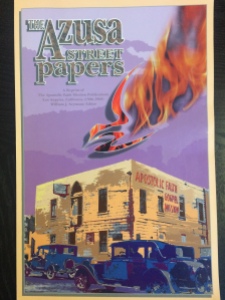
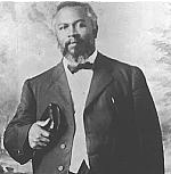
IMG_1337One of my co-workers just found and gave me a copy of The Azusa Street Papers which is a reproduction of the thirteen issues of The Apostolic Faith (1906-1908) published by the Apostolic Faith Mission at Azusa Street (Los Angeles, CA) by William J. Seymour. It records countless testimonies of the redemptive and empowering work of the Lord Jesus from around the world as the Spirit was being poured out on all flesh. This journal was key in spreading the Pentecostal message in those early years connected to the revival at the Mission.

William_seymour

William J. Seymour


While I typically give out down-sized copies from a PDF of the first several issues in my Pentecostal Heritage class, I was overjoyed to receive this volume that now allows me to show the students the papers in their original size and to personally own the papers (which are otherwise publicly available free of charge). This volume also includes a glossary of terms and an extensive index of terms and names.
Related to this, I would be remiss to not mention that one can access these papers (and many others at pentecostalarchives.org. This website is an invaluable tool for those interested in researching early Pentecostalism. It is a consortium of databases containing many of the periodicals and minutes of Pentecostal history. It also includes blog posts and book reviews on related subjects.
I have a strong interest in early Pentecostal literature for numerous personal reasons:

  • I am currently writing on the early Pentecostal interpretations of certain Biblical texts (Joshua through Kings),
  • I have taught a course numerous times on the history and theology of Pentecostalism/s,
  • I serve on the Library and Research Committee of the Society for Pentecostal Studies,
  • I find my own faith to be enlivened and challenged in the reading of these early works,
  • and I long for a wider audience to enjoy the benefit of open access to such resources.

All of this being said, if you have (or know of) any literature or audio/video materials related to early Pentecostalism I would encourage you to contact one of the organizations associated with the Consortium of Pentecostal Archives. Particularly the leading holder and purveyor of such: The Flower Pentecostal Heritage Center.
And thanks for the gift, Twyla! I am nerding out on early Pentecostal history. 🙂

Posted in Apostolic Faith, Pentecostal | Tagged , , , , , , , | 1 Comment

Two Literary Women of Pentecost

As I pour over the early Pentecostal periodicals, I am struck that despite the many limitations concerning leadership placed upon women within Pentecostal fellowships, there were numerous women preachers and writers who were making profound impact for the Kingdom.
Several women appear throughout these journals: Pandita Ramabai receives mention for her work in India, Maria Woodworth-Etter was used mightily to heal the sick, and Aimee Semple McPhearson boldly preached the full gospel message. While these names at least bear mention in many volumes dealing with Pentecostal history (due to their public ministries), I am yet more impressed by, and grateful for, the literary work of the likes of two women I wanted to highlight that have impacted me as I work on my PhD studies: E.A. Sexton and A.R. Flower.
Elizabeth A. Sexton initially served as the associate editor for G.B. Cashwell’s Atlanta based journal Bridegroom’s Messenger (founded 1907), but in 1908 took the helm as editor until 1923  at which point she was followed by her daughter, Hattie M. Barth. These two women (along with Hattie’s husband, Paul) founded The Association of Pentecostal Assemblies in 1921 (later merging into The International Pentecostal Church of Christ which still maintains the Bridegroom’s Messenger as its official periodical).  She also was the impetus (and a founding trustee) for Hattie and Paul to launch a Pentecostal school in Atlanta known as Beulah Heights Bible Institute (now Beulah Heights University). Sexton gave voice to thousands of Pentecostals spread across the globe as she shared their articles, testimonies, and letters along with her own editorial works.

Alice Reynolds Flower

Alice Reynolds Flower


Another woman who has stood out in my research is Alice Reynolds Flower who, along with her husband J. Roswell, founded The Christian Evangel in 1913 (which later became The Pentecostal Evangel and the official publication of the Assemblies of God). She contributed the weekly Sunday school lessons in the Evangel along with providing numerous poems and books addressing spiritual matters. (HERE is an interview with her in 1980 by Delbert Tarr concerning the early years of the U.S. Pentecostal movement and the founding of the A/G).
These women are unsung champions of the Pentecostal faith. They wrote and edited works over those early formative decades to help spread the message of Jesus in His fullness as Savior, Sanctifier, Baptizer in the Holy Spirit, Healer, and Soon Coming King. And I, for one, am grateful for their faithful work and witness! May the Father raise up many more such daughters to carry forward His mission to the world!

Posted in Pentecostal, women | Tagged , , , , , , | Leave a comment

What Is Your Story?

My StoryI don’t know about your church, but in mine we typically have an open testimony time (hey, we are Pentecostal after all). We like to tell our stories and that sure works well (sometimes not so much) in a post-modern personal narrative obsessed culture.
What I’m thinking of, though, is your story of first knowingly encountering Christ. Do you recall what he has done in your life? Do you remember a moment (or perhaps a longer time period) of the dawning of your need for him? It is a powerful reminder to think on your own story of encountering the resurrected Jesus in the power of his Spirit. We need to remind ourselves as those tasked with leading the church of this (ongoing) story and remind ourselves of where we’ve been led personally and congregationally. We need to allow our churches to share and relive their own stories, even as they continue to encounter Jesus in new ways in their lives. To re-awaken that first transformative love for Christ and his work in the world is to re-awaken ourselves to sharing the good news of Jesus with others.
I was reminded of my own story the other day (which I won’t share here and now) as I was listening to another pastor share his own story of being set free from a life of selfishness, drugs, and sex (his own words). A life being destroyed by sin. And then he shared his wife’s story of coming to faith as a six year old raised in a Christian home. The thing is: both stories are radically invigorating to hear and he admitted as much. After all, what isn’t amazing about the dead being raised to life? Neither story is about simple reform of sinners. Both are about those once dead in their sins who are now raised to new life in Christ. That is the amazing wonder of a regenerating encounter with the Lord and Giver of Life.
So my question is: Do you allow for folks in your church community to share their stories of encounter with the Lord and his redemptive work? When was the last time you shared yours?
_____________
Edited from an original post by me at bluechippastor.org from March 6, 2013.

Posted in Testimony | Tagged , , , , , | Leave a comment

A Brief Snake Handling Journey

I visited Tennessee this week to meet with my PhD supervisor (who is based in Cleveland even though my school is Bangor University, Wales). I had decided this visit that since I was “in the neighborhood” of the origins of the “serpent handler” churches, I’d like to visit the original site: Dolly Pond Church of God With Signs Following (you know its fun when a church name is that long).
As it happens, I also do a lecture on the origin and theology of snake handling for an undergraduate course I teach every Spring–Pentecostal Heritage. In part, I do this lecture as my final lecture of the semester in order to assure students will show up on the last day of class. I also do it because…well…its just plain fascinating to me and thus a fun way to end the course.
A Brief History of the Founder
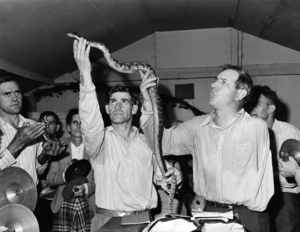
The “founder” of snake handling churches, George Hensley, had been a moonshiner who came to the Lord at special meetings held by Homer Tomlinson just north of Cleveland, TN. Hensley took to preaching himself around Owl Hollow (eventually joining the Church of God Cleveland TN for a time) and was doing so on Mark 16:17-20, but some of his former moonshining buddies thought to scare off the meeting by tossing a box of poisonous snakes into their midst. While the congregation fled in terror, Hensley snatched up the snakes “like a boy would gather stovewood in his arms to carry into the house” (Tomlinson p. 41). This was apparently the beginning of Hensley handling serpents, but appears to have created quite a sensation throughout the region gaining the attention of A. J. Tomlinson. Of note is an invitation in 1914 by A. J. Tomlinson to Hensley to the General Assembly of the Church of God (Cleveland, TN) in order to demonstrate the handling of serpents. Hensley apparently had a difficult time in life as he was married four times and went back and forth preaching and handling snakes to making moonshine even spending time jailed for both practices (Olsen p.24). A not-so-surprising end, he died on July 24, 1955 as the result of a snake bite for which he denied medical care and was declared to have committed “suicide”.

300px-Snakehandling

Snake handling service held in Lejunior, Harlan County, Kentucky at the Pentecostal Church of God, September 15, 1946 (National Archives and Records Administration, photo by Russell Lee)


My Surprises
I set up my visit to see the site of the Dolly Pond Church of God With Signs Following (Hensley’s church which was torn down decades ago). Church of God historian Dr. David Roebuck kindly arranged the trip north a half hour to Owl Hollow and Dolly Pond. As it turned out he had asked Bishop Wade Phillips to guide us. Bishop Phillips had just published the first volume of a series on the history of the Church of God and I was familiar with his work. This was a pleasant surprise tour guide.
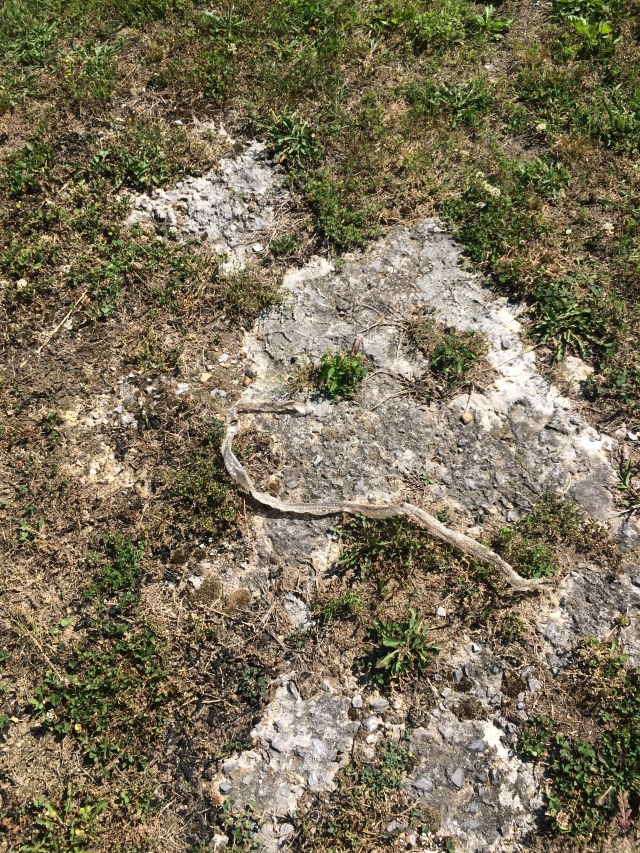
We arrived at the site (where now a Church of God of Prophecy stands nearby) and saw something laying on what appeared to be the foundation of the Dolly Pond church we were looking for. It was a sloughed snake skin. A delightful find indeed. Especially as it was not a live snake. 🙂
 
 
IMG_1256

Sloughed snake skin on the “foundation” of the location of the Dolly Pond Church of God with Signs Following.


Naturally we posed with the serpent remains.
IMG_1260

Bishop Wade H. Phillips, Dr. David G. Roebuck, and myself (holding the sloughed snake skin we found)


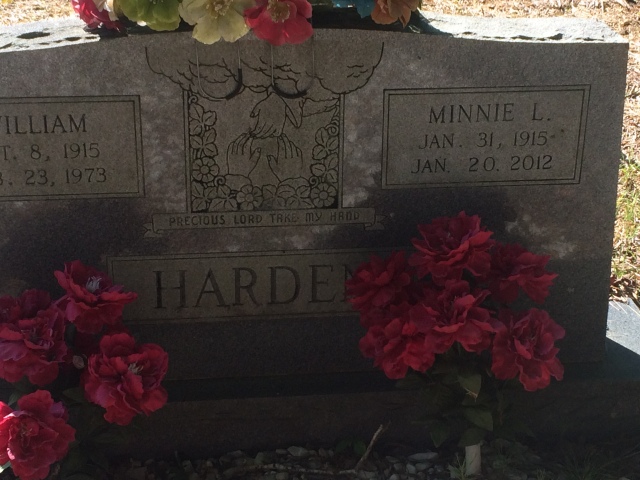
While wandering around the site, Phillips mentioned that he had been told (some 20 years prior by a nearby neighbor) that there was a small gathering of graves up on a hill near where the church had stood. We climbed the hill in search of the graves of potential members of the Dolly Pond Church of God With Signs Following and were again delighted by our find. We found a grave of one “Minnie L. Harden” (maiden name of Parker) buried near her parents Ben and Maggie Parker.
IMG_1263

Minnie L. (Parker) Harden’s grave on the hill just up from the Dolly Pond Church of God with Signs Following


IMG_1266

Picture from W.H. Phillips, “Quest to Restore God’s House” p. 356.


As it turned out Minnie had been pictured in Phillips’ book Quest to Restore God’s House: A Theological History of the Church of God (Cleveland, Tennessee) Volume 1, 1886-1923, where she has a rattlesnake draped across her forehead with the sign “The Dolley [sic] Pond Church of God With Signs Following” just over her shoulder.
While I know this is not a typical trip (for anyone), it was a fun historical adventure reminding me of locating historical figures and movements in their times and contexts. It also reminds me that even when I vehemently oppose a practice I can still appreciate the sense of experiencing the stories of others and how they may have handled issues of faith and practice.
Works Cited
Olsen, Ted. “They Shall Take Up Serpents,” Christian History 17.2 (May 1998): p.24.
Phillips, Wade H. Quest to Restore God’s House: A Theological History of the Church of God (Cleveland, Tennessee) Volume 1, 1886-1923. Cleveland, TN: CPT Press, 2014.
Tomlinson, Homer A. “It Came to Pass in Those Days”: The Shout of a King. Queens Village, N.Y.: Church of God, U.S.A. Headquarters, 1968.
 

Posted in History, Pentecostal, snake handling | Tagged , , , | 1 Comment

Student FAQ for the Society for Pentecostal Studies

SPS Student CaucusWhile this is not an official FAQ of the Society for Pentecostal Studies (SPS), I offer it in response to a series of questions I was asked by a friend who is a student member wishing to submit a proposal for a paper to be presented at an SPS Annual Meeting. I have also offered a few of my own questions which I thought might be beneficial. I have been an active member of the Society since 2008 and helped to found the SPS Student Caucus in order to assist students in developing as scholars within the broad field of Pentecostal studies and as Pentecostal scholars. I believe my responses to his questions might prove helpful to others who might also be wondering similar things about writing and presenting research for SPS.

What is the standard length of a paper submitted to SPS?

There is no official standard length for papers. Some present papers of only 10 pages while others have submitted papers over 50 pages. The key is how much time your session will allow for presentation and questions afterward. Typically there is about 20-30 minutes for presentation and questions which means a paper of 15-20 pages is almost all that one has time to read in that timeframe. Longer papers are not discouraged, but that means much of the material will need to be summarized rather than shared outright.

Does the paper have to be completely written before you submit a proposal?

No. For student members it is better to have already written the paper (or much of the paper) prior to submission of the proposal since it can be difficult to meet the time demands of writing a paper after being approved. Proposals are submitted by the June deadline, approved by August-September then the paper is expected to be submitted in January. While this sounds like a lot of time it can slip away rather quickly in the midst of study and work. You also will need to be registered for the conference by November 1 to guarantee your submission (if it had been accepted) remains on the schedule and is not removed to make room for others who may be backups.

Does a paper have to fit the theme for SPS?

No. It is helpful to use the proposed theme for the upcoming meeting in order to offer something which is more likely to be approved, but members are welcomed to submit on any number of topics which may or may not have anything to do with the overall theme.

What should I include in my proposal abstract?

It can be as little as needed to state briefly and pointedly what you will do (or intend to do), how you might do it (methodology), what anticipated outcomes are (or might be) and why it matters. Some can say this all in a 150 words. Some the maximum. It is recommended to write it out elsewhere to copy and paste into the SPS proposal form when you are ready. There are plenty of members of SPS (myself included) who would be delighted to even take a look ahead of time to give any helpful comments on content, focus, etc. While not all of us are great at responding in quick order, many are.

What interest group do I submit my proposal to and what if there is more than one that might fit?

Feel free to submit it to any interest group you think best fits what you are doing in the intended paper. I’ve presented in numerous of our interest groups without being a member of them (I’ve always been in Biblical studies as my primary focus). You can always make a note in the submission form that you believe your proposal might fit another group and request if it is thought by the interest group chair to better fit elsewhere (for whatever reason) to forward it to them. You might also consider adding a notation that you are a student member as our Society looks to engender wide participation of student members. Also, consider submitting your paper for the Young Scholars Award (if you are a masters level student) or the Ithiel Clemmons Student Travel Award (if you are a racial/ethnic minority and/or woman).

Are all papers that are accepted also presented at the SPS conference?

That is the agreement made when submitting the proposal. If a student submits a proposal they are agreeing to write the paper, renew their membership, and attend the conference to present. The approval process is approving papers for presenting and the schedule of the conference is developed according to the papers approved.

How would I go about finding 2 respondents?

It isn’t necessary to have two respondents, but if you know people who are a part of SPS and might have some expertise or interest in your topic then they can be included. Most papers do not have respondents in my experience. I’ve only ever had one respondent and it was not even a person that I knew nor had I put their name down, but they were an expert in the field and their feedback was excellent.

I have done something similar for my thesis/dissertation, but I haven’t written a paper for a conference yet. Is this something I should wait on and try to attend SPS and see how it is done?

You are always welcome to attend an SPS conference to see how such things flow. Many other conferences function similarly so it isn’t necessary to attend SPS to see how an academic conference can be run. However, the spirituality and the comradery of SPS are unlike any conferences I have had the pleasure of sharing in or attending. I would personally say that presenting at SPS is an excellent opportunity for students beginning their engagements within the broader academic world as the members of SPS are primarily sympathetic and constructive. You would likely find that the feedback and engagement with your presented work will benefit its further development.

How would I join a special interest group?

You “join” a special interest group by attending that group’s meeting at the annual SPS meeting. It is as simple as saying you want to be a part of a particular group because you feel it intersects best with your reason for being a part of SPS. When filling in the interest group information online for your proposal simply select the group which seems to best fit the broad field of study being proposed. For instance, several years ago I wrote on an engagement between Post Modern and Pentecostal homiletics so I submitted the proposal to the “Practical Theology” interest group. My typically writes philosophical works and thus typically submits to the “Philosophy” interest group. Most years I propose something that is primarily exegetical (with theological orientation) and thus submit my proposals to the “Biblical Studies” interest group.

I trust these are helpful and would welcome any further questions that are felt to be pertinent particularly to student members of the Society.

Posted in FAQ, Society for Pentecostal Studies | Tagged , | Leave a comment

SPS 2017 Proposal Submitted

I just submitted my proposal for the 2017 Society for Pentecostal Studies annual meeting in St. Louis, MO. It is always a bit daunting preparing for a presentation at a scholarly society, but I have always found the effort well rewarded by the responses and engagement at the time of presentation. My title is Toward a Pentecostal Hermeneutic of the Former Prophets. Here is my proposal synopsis:

While there is no singular Pentecostal hermeneutic (nor a singular definition of ‘Pentecostal’), and some still persist in questioning whether there is or should be any, there are noticeable trends toward more clearly defined Pentecostal hermeneutics while still ‘in the making’. Perhaps this ‘still in the making’ is part and parcel of the Pentecostal’s sanctified/sanctifying interpretation. Claims to any form of Pentecostal hermeneutics must admit no ‘claim to possess a pristine and qualitatively unique methodology’. Instead, every hermeneutical approach (including those which might be called Pentecostal) is distinguished ‘by the presuppositions on which they build, the questions that they privilege, the interpretive tools they prefer, and the texts to which they attend’. Such a hermeneutical approach is perhaps properly always in the making as an improvisational performance of the Word by the Spirit within the community.
This paper briefly traces the four broad streams of historical development with the Pentecostal community’s hermeneutics as outlined by V. Kärkäinnen: Oral pre-reflexive, Fundamentalist-Evangelical, pneumatic exegesis and an emerging post-modern movement. This last movement is followed more closely as it unfolds in a triadic form in developing the hermeneutic suggestive by the text of the Former Prophets within the Pentecostal community taking into account the recent work on this trajectory by Scott Ellington, J. Christopher Thomas, Kenneth Archer, and Amos Yong (among others). A proposed phenomenological experience of the text by the Pentecostal community is offered toward a narrative approach to the text of the Former Prophets.

And in case you were wondering … “Former Prophets” refers to the books of the Hebrew Bible / Old Testament known as Joshua, Judges, 1-2 Samuel, and 1-2 Kings. 🙂

Posted in Former Prophets, Hermeneutics, Pentecostal hermeneutics, Society for Pentecostal Studies | Tagged , | Leave a comment

Thinking Big About Pastors of Small Churches

Church sign
I am delighted with the growing interest in helping small church pastors be the best pastors (and their congregations the best congregations) they can be. Serving faithfully wherever God calls. One recently discovered resource is offering a plethora of helps for small church pastors and Karl Vaters has apparently only been at it for 100 days (but WOW! has he done a LOT in that time). What a terrific day and age to be a small church pastor. There are opportunities like never before to serve our communities and be resourced to bring greater glory to God.
With that in mind, I was listening to a message by pastor Mark Dever delivered at the recent Desiring God conference for pastors. He shared a quote–that has stayed with him and made impact in his own life and ministry–that I was struck by:
John Brown in a letter of paternal counsels to one of his pupils newly ordained over a small congregation:

“I know the vanity of your heart, and that you will feel mortified that your congregation is very small, in comparison with those of your brethren around you; but assure yourself on the word of an old man, that when you come to give an account of them to the Lord Christ, at his judgment-seat, you will think you have had enough.”

And while you are at it, check out his first message on being a discipling pastor in a discipling community titled “Centrality of the Church in Discipleship” (neatly summarized toward the end by the poetic: Preach and Pray, Love and Stay). Love it!
____________________
Originally blogged by myself at bluechippastor.org on February 27, 2013.
Three years later, I am even more passionate about seeing pastors of small congregations succeed in doing what the Lord has called them to do. I say this as one who regularly preaches to gatherings of a few dozen and has pastored churches of 20-60 congregants. I am also grateful to serve in an institution like Trinity Bible College and Graduate School that equally cares for churches of all sizes and the pastors called to serve them.

Posted in Church, Pastor | Tagged , , | 1 Comment